Friday, December 27, 2013

New Banking Product : iWish Recurring Deposit

Review of iWish Recurring Deposit from ICICI Bank : Jagoinvestor


Posted: 25 Dec 2013 09:58 PM PST
Around December last year, ICICI Bank launched a flexible Recurring Deposit scheme called “iWish”. Customers with an ICICI savings account and who have access to Internet banking can use the iWish facility. Here’s how
  • Login to the iWish section in your ICICI saving bank account
  • Define a goal (like buying a laptop, vacation, down-payment on a house, etc.)
  • Define the amount and tenure
  • Make the starting contribution and the iWish goal starts
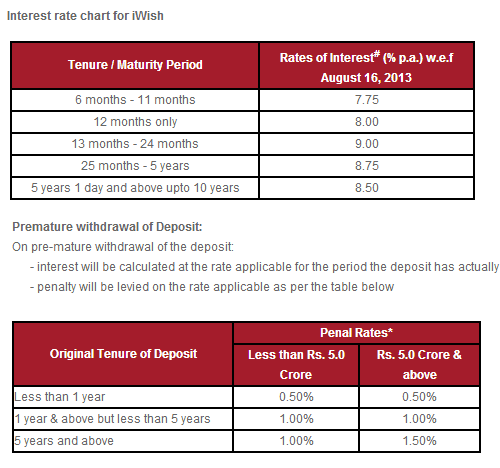
After this point, you are free to deposit additional money in your iWish account anytime you have surplus funds. Also, you can clearly see how much of goal is completed in % terms at any stage of the process. Interest rates on the iWish scheme range between 7.75% and 8.5%. Rates depend on the tenure of your goal – which can be between 6 months and 10 yrs.

ICICI iWish scheme Interest rates and Penalty rates
Source Page

Where iWish really innovates, is by bringing a social networking aspect into the picture. Users have the ability to share their goals (and the money required to achieve them) on their Facebook account and friends and family can then contribute money to the goal if they wish. By getting users to make a public declaration of their goal, the scheme hopes to prompt greater accountability in individual financial decisions.
To learn more about ICICI iWish Scheme, please watch the video below.


How its different from normal Recurring Deposit ?

Compared to a standard Recurring Deposit, the iWish scheme does not make it compulsory for users to make payments on a fixed date and also gives them the power to categorize savings into goals – which is a more human way to visualize and save your money.
Personally, I see iWish as a mechanism to define goals and save for them through Recurring Deposits. While standard Recurring Deposits just help save money for an unlabeled goal, iWish helps you define and prioritize your goals – helping you decide which goal to save for first. It also helps build a focused saving approach as once someone defines a goal, they are more likely to be serious about achieving it.
The scheme is clearly going to benefit the young generation, who are new to investing. For a generation who rely a lot on visual stimuli, the ability to see defined goals and a visual image of progress towards that goal (e.g. 34% of your ‘new car’ goal has been achieved) is a huge plus.

Fine Prints and things to know

While, on the whole, the iWish Scheme is good, there are few things one should be aware of to avoid a mismatch with expectations.
  • One can create maximum of 10 goals (wishes) and the maximum goal amount can be Rs 10 lacs
  • The minimum installment amount per month has to be Rs 500
  • If you want to withdraw the money on maturity or even before maturity, you need to open a request online for that.
  • There is no compulsion of making payments each month, so you can skip the installments if you want

Disadvantage of iWish from ICICI

By now, you must be wondering what the downsides of the iWish scheme are? Simply put, it is the problem of “manual intervention”.
I am convinced that it takes a great degree of resolve and discipline to properly manage one’s personal finance and investments. Unless the saving process is automated, people are tempted to be a little relaxed about saving in every period. While iWish touts its ‘flexibility’ as an innovative feature, in real life it might not help, as people are more likely to stop ‘voluntarily’ paying into their goals after 2-3 contributions.
With a traditional recurring deposit, the process of investing is compulsory and forced on you and in essence, you are compelled to make payments on a fixed date. Furthermore, the knowledge that there is an auto-debit leads you to ensure the monies are there in the account on the designated date. All this means that over 1-2 years, the Recurring Deposit really works and creates the money pool you need. While iWish is a fancy product, I do not see it as an improvement over the traditional Recurring Deposit.
Only in selected conditions and situations, iWish seems to work better than normal Recurring Deposit. An example would be when the investor’s income is not stable (one does not know if the bank account will really have the required balance on a certain date). For all other cases, I would prefer using traditional Recurring Deposits. Choose a goal, fix the amount, divide it by number of months and just start the RD for that amount. That should get the job done without needing my involvement every month.

Wednesday, December 25, 2013

Fairytale of Beijing

( From Letters to the Editor, the
Economist)


SIR – Perhaps China will worry its neighbours further and make a claim that the North Pole is actually an extension of northern China, as found on an ancient map made during the Qing dynasty (“Regional turbulence”, November 30th). An air exclusion zone will be implemented and even Santa Claus will need to file a flight plan or be challenged by Chinese stealth fighters.
Its added leverage is that most of Santa’s toys are made in China, as many elves were laid off for cost-cutting reasons elsewhere. Santa will eventually become a citizen of the North Pole Special Autonomous Region and enjoy Chinese consular protection.
Neil Alexander
Vancouver  

MySnaps : Ancient Daitya Sudan Temple, Lonar

Daitya Sudan Temple has beautiful carvings similar to what is seen at Khajuraho temples. The deity of this temple is made of an ore with high metal content and looks like stone. Area out-side the sanctum is dark and the ceiling reveals beautiful carvings under a torch light. It is a Vishnu temple dated to the Chalukya Dynasty which ruled Central and Southern India between the 6th and 12th centuries. It belongs to the Hemadpanthi class and is built in the form of an irregular star. The exterior walls are covered with carved figures. The temple has beautiful carvings similar to what is seen at Khajuraho temples. The deity of this temple is made of an ore with high metal content and looks like stone. Area out-side the sanctum is dark and the ceiling reveals beautiful carvings under a torch light.The plinth of the temple is about 1.5 m in height and was probably destroyed by the invaders. Some of my pictures from the site :
Inline image 1

Inline image 2

Inline image 3

Inline image 4

Four Stages of Life !


Thursday, December 19, 2013

IBM reveals its top five innovation predictions for the next five years


IBM reveals its top five innovation predictions for the next five years
IBM
IBM director of education transformation Chalapathy Neti.
December 16, 2013 10:30 PM


IBM revealed its predictions for five big innovations that will change our lives within five years.
IBM

The IBM “5 in 5″ is the eighth year in a row that IBM has made predictions about technology, and this year’s prognostications are sure to get people talking. We discussed them with Bernie Meyerson, the vice president of innovation at IBM, and he told us that the goal of the predictions is to better marshal the company’s resources in order to make them come true.
“We try to get a sense of where the world is going because that focuses where we put our efforts,” Meyerson said. “The harder part is nailing down what you want to focus on. Unless you stick your neck out and say this is where the world is going, it’s hard to you can turn around and say you will get there first. These are seminal shifts. We want to be there, enabling them.”
In a nutshell, IBM says:
  • The classroom will learn you.
  • Buying local will beat online.
  • Doctors will use your DNA to keep you well.
  • A digital guardian will protect you online.
  • The city will help you live in it.
Meyerson said that this year’s ideas are based on the fact that everything will learn. Machines will learn about us, reason, and engage in a much more natural and personalized way. IBM can already figure out your personality by deciphering 200 of your tweets, and its capability to read your wishes will only get better. The innovations are being enabled by cloud computing, big data analytics (the company recently formed its own customer-focused big data analytics lab), and adaptive learning technologies. IBM believes the technologies will be developed with the appropriate safeguards for privacy and security, but each of these predictions raises additional privacy and security issues.
As computers get smarter and more compact, they will be built into more devices that help us do things when we need them done. IBM believes that these breakthroughs in computing will amplify our human abilities. The company came up with the predictions by querying its 220,000 technical people in a bottoms-up fashion and tapping the leadership of its vast research labs in a top-down effort.
Here’s some more detailed description and analysis on the predictions.
In five years, the classroom will learn you.
IBM
In five years, the classroom will learn you to help tailor instruction to your individual needs.

The classroom will learn you

Globally, two out of three adults haven’t gotten the equivalent of a high school education. But IBM believes the classrooms of the future will give educators the tools to learn about every student, providing them with a tailored curriculum from kindergarten to high school.
“Your teacher spends time getting to know you every year,” Meyerson said. “What if they already knew everything about how you learn?”
In the next five years, IBM believes teachers will use “longitudinal data” such as test scores, attendance, and student behavior on electronic learning platforms — and not just the results of aptitude tests. Sophisticated analytics delivered over the cloud will help teachers make decisions about which students are at risk, their roadblocks, and the way to help them. IBM is working on a research project with the Gwinnett County Public Schools in Georgia, the 14th largest school district in the U.S. with 170,000 students. The goal is to increase the district’s graduation rate. And after a $10 billion investment in analytics, IBM believes it can harness big data to help students out.
“You’ll be able to pick up problems like dyslexia instantly,” Meyerson said. “If a child has extraordinary abilities, they can be recognized. With 30 kids in a class, a teacher cannot do it themselves. This doesn’t replace them. It allows them to be far more effective. Right now, the experience in a big box store doesn’t resemble this, but it will get there.”
In five years, buying local will beat online as you get online data at your fingertips in the store.
IBM
In five years, buying local will beat online as you get online data at your fingertips in the store.

Buying local will beat online

Online sales topped $1 trillion worldwide last year, and many physical retailers have gone out of business as they fail to compete on price with the likes of Amazon. But innovations for physical stores will make buying local turn out better. Retailers will use the immediacy of the store and proximity to customers to create experiences that online-only retail can’t replicate. The innovations will bring the power of the Web right to where the shopper can touch it. Retailers could rely on artificial intelligence akin to IBM’s Watson, which played Jeopardy better than many human competitors. The Web can make sales associates smarter, and augmented reality can deliver more information to the store shelves. With these technologies, stores will be able to anticipate what a shopper most wants and needs.
And they won’t have to wait two days for shipping.
“The store will ask if you would like to see a certain camera and have a salesperson meet you in a certain aisle where it is located,” Meyerson said. “The ability to do this painlessly, without the normal hassle of trying to find help, is very powerful.”
This technology will get so good that online retailers are likely to set up retail showrooms to help their own sales.
“It has been physical against online,” Meyerson said. “But in this case, it is combining them. What that enables you to do is that mom-and-pop stores can offer the same services as the big online retailers. The tech they have to serve you is as good as anything in online shopping. It is an interesting evolution but it is coming.”
In five years, doctors will routinely use your DNA to keep you well.
IBM
In five years, doctors will routinely use your DNA to keep you well.

Doctors will use your DNA to keep you well

Global cancer rates are expected to jump by 75 percent by 2030. IBM wants computers to help doctors understand how a tumor affects a patient down to their DNA. They could then figure out what medications will best work against the cancer, and fulfill it with a personalized cancer treatment plan. The hope is that genomic insights will reduce the time it takes to find a treatment down from weeks to minutes.
“The ability to correlate a person’s DNA against the results of treatment with a certain protocol could be a huge breakthrough,” Meyerson said. It’ll be able to scan your DNA and find out if any magic bullet treatments exist that will address your particular ailment.
IBM recently made a breakthrough with a nanomedicine that it can engineer to latch on to fungal cells in the body and attack them by piercing their cell membranes. The fungi won’t be able to adapt to these kinds of physical attacks easily. That sort of advance, where the attack is tailored against particular kinds of cells, will be more common in the future.
In five years, a digital guardian will protect you online.
IBM
In five years, a digital guardian will protect you online.

A digital guardian will protect you online

We have multiple passwords, identifications, and devices than ever before. But security across them is highly fragmented. In 2012, 12 million people were victims of identity fraud in the U.S. In five years, IBM envisions a digital guardian that will become trained to focus on the people and items it’s entrusted with. This smart guardian will sort through contextual, situational, and historical data to verify a person’s identity on different devices. The guardian can learn about a user and make an inference about behavior that is out of the norm and may be the result of someone stealing that person’s identity. With 360 degrees of data about someone, it will be much harder to steal an identity.
“In this case, you don’t look for the signature of an attack,” Meyerson said. “It looks at your behavior with a device and spots something anomalous. It screams when there is something out of the norm.”
In five years, the city will help you live in it.
IBM
In five years, the city will help you live in it.

The city will help you live in it

IBM says that, by 2030, the towns and cities of the developing world will make up 80 percent of urban humanity and by 2050, seven out of every 10 people will be a city dweller. To deal with that growth, the only way cities can manage is to have automation, where smarter cities can understand in real-time how billions of events occur as computers learn to understand what people need, what they like, what they do, and how they move from place to place.
IBM predicts that cities will digest information freely provided by citizens to place resources where they are needed. Mobile devices and social engagement will help citizens strike up a conversation with their city leaders. Such a concept is already in motion in Brazil, where IBM researchers are working with a crowdsourcing tool that people can use to report accessibility problems, via their mobile phones, to help those with disabilities better navigate urban streets.
Of course, as in the upcoming video game Watch Dogs from Ubisoft, a bad guy could hack into the city and use its monitoring systems in nefarious ways. But Meyerson said, “I’d rather have the city linked. Then I can protect it. You have an agent that looks over the city. If some wise guy wants to make the sewage pumps run backwards, the system will shut that down.”
The advantage of the ultra-connected city is that feedback is instantaneous and the city government can be much more responsive.
Tuesday, December 17, 2013

India poised to become global solar power: World Bank

The Jawaharlal Nehru National Solar Mission Phase-1 (JNNSM) is well-poised to make India a global leader in the development of solar power as its green growth agenda increased the installed capacity of solar power from around 30 MW to more than 2,000 MW, a new World Bank report said on Thursday.
What is significant is that JNNSM has been instrumental in bringing down the cost of solar power to a level that is competitive across the world, says the report. It has reduced the costs of solar energy to $0.15 per kWh, making India amongst the lowest cost destinations for grid-connected solar Photovoltaic (PV) in the world.
The report, ‘Paving the Way for a Transformational Future: Lessons from JNNSM Phase1’ says solar power can reduce India’s dependence on imports of diesel and coal for power generation, reduce greenhouse gas emissions, and contribute to energy security. Growth in this sector will help India increase its share of clean energy and help meet its target of reducing emissions per unit of its GDP by 20-25 per cent by 2020 over 2005 levels. 
“In a short span of three years, India has made impressive strides in developing its abundant solar power potential. With more than 300 million people without access to energy and industry citing energy shortage as key growth barrier in India, solar power has the potential to help the country address the shortage of power for economic growth,” Onno Ruhl, World Bank Country Director in India said at the release of the report. 
However, while India is clearly emerging as a global leader in the area of solar power, to achieve its target of adding 20,000 MW of solar capacity by 2022, “it needs to address the key barriers and constraints that could come in the way of scaling up the solar program”, he added.
“Building on the success of Phase 1, the programme now needs to focus on promoting financing of solar projects by commercial banks, developing shared infrastructure facilities such as solar parks and identifying comparative advantage of Indian manufacturing across the supply chain,” Ashish Khanna, lead energy specialist and one of the authors of the report said.
The report has recommended publicly developed infrastructure such as solar parks to help increase efficiency and lower costs. A solar park in Charanka (Patan district) in Gujarat is now the largest solar park in Asia. Such shared infrastructure facilities helps in developing critical infrastructure, including facilities for power transmission, roads and water, thereby ensuring the rapid development of solar projects as well as local employment generation, the report added. In addition, India’s plans to develop ultra-mega solar projects will help showcase the potential for large scale grid connected solar projects to the entire world, it says.